The definitive guide to residential swimming pool building codes in Southwest Florida. From the Florida Building Code to local setback requirements — everything you need to know before building or renovating your pool.
These requirements apply to ALL residential swimming pools in Florida, regardless of jurisdiction. Local codes may impose additional or more restrictive standards.
Minimum setback distances vary by jurisdiction. Always verify with your local building department as zoning overlays and deed restrictions may impose greater setbacks.
| Jurisdiction | Pool Shell (Rear) | Pool Deck | Screen Enclosure | Waterfront |
|---|---|---|---|---|
| Collier County | 10 ft | 5 ft (accessory) | 5 ft side / 10 ft rear | 20 ft if deck > 4 ft above seawall |
| City of Naples | Per zoning district | Per Sec. 56-45 | Per Sec. 56-45 | CCCL requirements apply |
| Marco Island | Per zoning + deed restrictions | 15 ft from water | Per Sec. 30-1004 | 18 ft from water to pool edge |
| Bonita Springs | 19 ft (some zones) | Per zoning district | Per zoning district | Per Lee County Sec. 34-2194 |
| Lee County | 10 ft | 5 ft (accessory) | Accessory setbacks | Per Sec. 34-2194 |
Note: Setbacks shown are general minimums. Specific zoning districts, PUD overlays, and deed restrictions may require greater distances. Always confirm with your local building department before construction.
All residential swimming pools in Florida must comply with barrier requirements per the Florida Building Code, Residential, 8th Edition (2023), Sections R4501.17.1 through R4501.17.3.
Outdoor Swimming Pool Barriers (R4501.17.1):
Access Gates (R4501.17.1.8): Must be self-closing and self-latching. Latch located on pool side of gate. Gates must open outward away from pool. If release mechanism ≥ 54 inches from bottom, may be on either side. No opening greater than ½ inch within 18 inches of release mechanism.
Dwelling Wall as Barrier (R4501.17.1.9): When the home wall serves as part of the barrier, at least one of the following must apply: (1) Exit alarms on all doors/windows — minimum 85 dBA at 10 feet, UL 2017 compliant, deactivation switch ≥ 54 inches above threshold; (2) Self-closing, self-latching device on all doors — minimum 54 inches above threshold; (3) Pool alarm meeting ASTM F2208.
Screen Enclosures (R4501.17.1.11): Standard screen enclosures meeting R4501.17 requirements may serve as the pool barrier.
Removable Child Barriers (R4501.17.1.13): Must be placed ≥ 20 inches from water's edge and comply with ASTM F2286. One end must be nonremovable without tools.
All pool electrical work must comply with the National Electrical Code (NEC) Article 680 as adopted by the Florida Building Code.
Pool design must conform to ANSI/APSP/ICC standards 3, 4, 5, 6, and 7. Every pool must have a filter, pump, piping, valves, and component parts.
Energy Conservation (FBC Energy Code Section 403.9): Variable speed or multi-speed pumps are REQUIRED for pools ≥ 1 HP. Default circulation speed must be the lowest speed capable of maintaining proper filtration. Pumps must operate at minimum two speeds.
§515.27 Safety Feature Options: To pass final inspection and receive a certificate of completion, a residential swimming pool must meet at least one of five safety feature requirements (see Safety Features table above).
§515.29 Barrier Requirements: A residential swimming pool barrier must be at least 4 feet high on the outside, with no gaps allowing a young child to crawl under, squeeze through, or climb over. The barrier must be placed around the perimeter of the pool and sufficiently away from the water's edge. Gates must open outward, be self-closing and self-latching with the release mechanism on the pool side.
Virginia Graeme Baker Pool & Spa Safety Act (VGBA): All pool/spa drain covers must comply with ANSI/ASME A112.19.8 (or successor ANSI/APSP-16). Florida extends similar drain safety requirements to residential pools via the FBC and ANSI/APSP/ICC 7.
Per FBC-R Section R4501.19, the final electrical and barrier code inspection must be completed PRIOR to filling the pool with water.
Exception: Vinyl liner and fiberglass pools must be filled with water upon installation.
Pressure Test: All pool piping must be tested at a minimum of 35 psi for 15 minutes per FBC-R Section R4501.12.1.
Collier County's Land Development Code establishes the following minimum setback requirements for residential swimming pools:
Collier County requires the following documentation for a residential pool permit (PRSPL application):
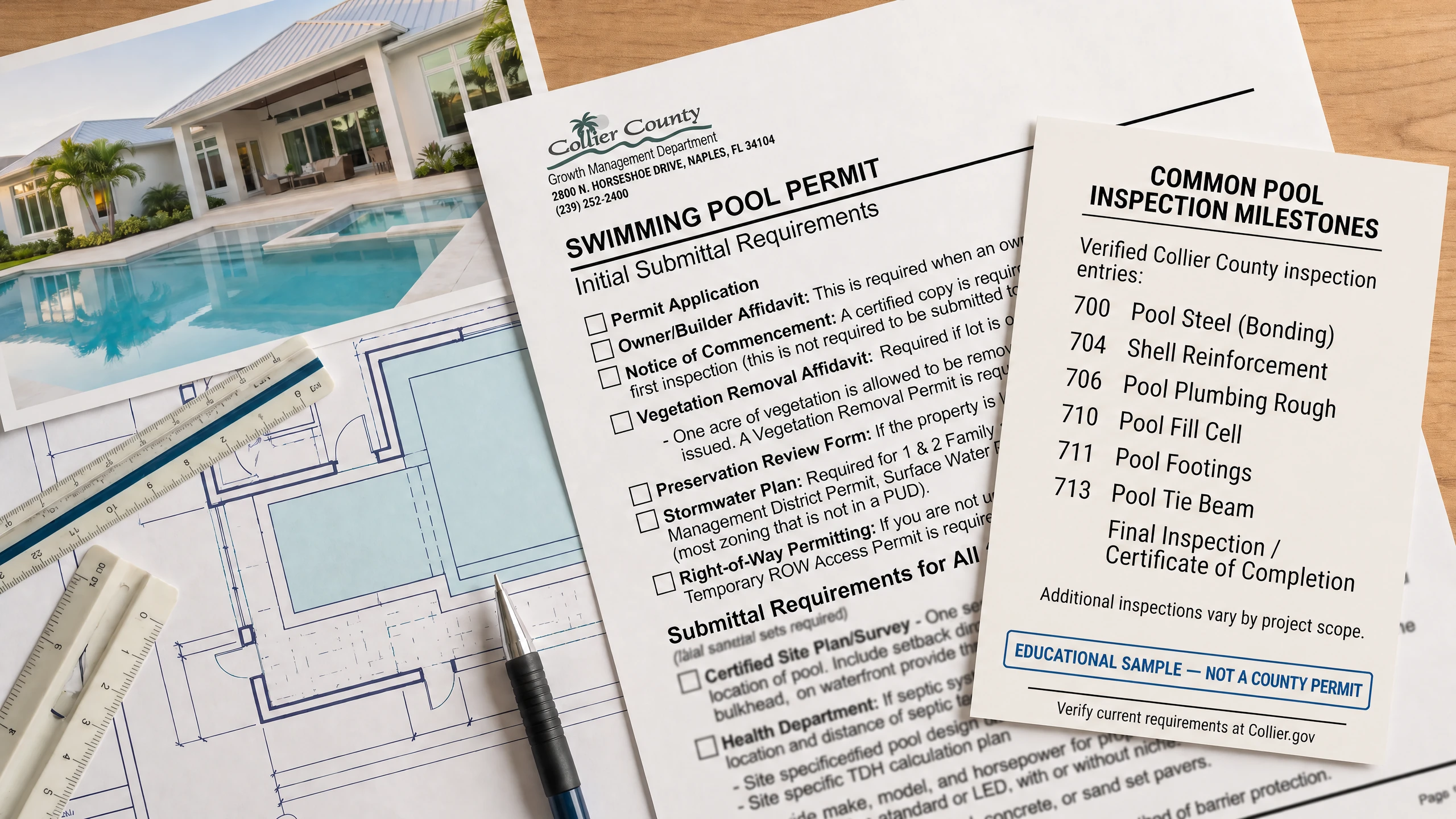
Collier County requires the following inspection sequence for residential pool construction:
Critical: Electrical and barrier inspection must be completed BEFORE filling the pool with water.
For existing occupied dwellings, pool alarms are inspected at the 502 inspection. For new construction that is not yet occupied, pool alarms are inspected at the 701 final pool inspection.
Collier County Growth Management Division
Permit applications: collier.gov/PRSPL
Phone: (239) 252-2400
The City of Naples has specific requirements for pool elevation and placement:
The City of Naples requires the following for a residential pool permit:
City of Naples pool permit fees (2025 schedule):
The City of Naples has several unique requirements that differ from county standards:
City of Naples Building Department
295 Riverside Circle, Naples, FL 34102
Phone: (239) 213-5000
The City of Marco Island has specific setback requirements that vary based on whether the property is waterfront:
Important: Deed restriction setbacks differ from City zoning setbacks — property owners must meet the MORE STRINGENT of the two. Always check both your deed restrictions and city zoning before planning your pool.
Marco Island uses the Citizen Self Service Portal for permit submissions:
City of Marco Island Building Services
50 Bald Eagle Drive, Marco Island, FL 34145
Phone: (239) 389-5000
Permit portal: cityofmarcoisland.com
The City of Bonita Springs follows the Lee County LDC Sec. 34-1176 framework (as a former unincorporated Lee County area) with some local variations:
Bonita Springs requires the following for pool permit applications:
Critical Rule: "A PERMANENT ENCLOSURE MUST BE IN PLACE AND BARRIERS/ALARMS MUST BE IN PLACE FOR THE 118 POOL SAFETY INSPECTION PRIOR TO FILLING POOL WITH WATER."
City of Bonita Springs Community Development Department
9220 Bonita Beach Road, Suite 111, Bonita Springs, FL 34135
Phone: (239) 444-6150
Lee County's Land Development Code Section 34-1176 establishes setback requirements for swimming pools, decks, and enclosures:
Lee County permit requirements for residential pools:
Lee County requires the following inspections for residential pool construction:
Lee County Building and Permitting Services
1500 Monroe Street, Fort Myers, FL 33901
Phone: (239) 533-8329
Email: econnect@leegov.com
Online permits: leegov.com/dcd
Have a specific code question? Get an instant answer from our AI.
Per Florida Statute §515.27, every residential swimming pool must meet at least one of the following safety feature requirements to pass final inspection and receive a certificate of completion.
| Option | Description | Standard |
|---|---|---|
| (a) Barrier/Enclosure | Pool isolated from home access by enclosure meeting §515.29 | FBC-R R4501.17 |
| (b) Safety Pool Cover | Approved safety pool cover | ASTM F1346 |
| (c) Exit Alarms | On all doors/windows providing direct pool access | UL 2017, min 85 dBA at 10 ft |
| (d) Self-Closing Doors | Self-closing, self-latching device on all doors to pool | Release ≥ 54" above floor |
| (e) Pool Alarm | In-water alarm detecting unauthorized entry | ASTM F2208 |
Failure to comply is a second-degree misdemeanor per F.S. §775.082/§775.083. Penalty waived if corrected within 45 days and drowning prevention education program attended.
Understanding the typical pool permit process in Southwest Florida helps you plan realistic timelines and avoid costly delays.
Structural engineer creates pool plans, site survey completed. Typical cost: $1,500–$3,000 for engineering.
Licensed contractor submits plans to local building department. Fees vary: Collier County ~$1,200–$2,500, Lee County ~$800–$1,800, Naples ~$1,000–$2,000.
Building department reviews structural, electrical, plumbing, and zoning compliance. Revisions may be required.
Once approved, permit is issued and posted at job site. Construction can begin. Permit valid for 180 days (6 months).
Multiple inspections required at key stages (see Inspection Schedule below). Each must pass before proceeding.
Certificate of Completion issued after final inspection passes. Pool can be filled and used. Barrier must be in place.
These are the most frequent issues we see homeowners and even some contractors encounter. Avoiding them can save weeks or months of delays.
✗ Starting construction before permit is issued
What happens: Stop-work order issued immediately. Fines up to $500/day. Must halt all work until permit obtained.
Prevention: Never break ground until the physical permit card is posted at the site.
✗ Not meeting setback requirements
What happens: Plans rejected during review. Pool must be redesigned, adding 2–4 weeks and additional engineering fees.
Prevention: Verify setbacks with your specific zoning district before finalizing design.
✗ Missing barrier inspection before filling
What happens: Per FBC-R R4501.19, barrier must be inspected before pool is filled. Violation requires draining.
Prevention: Schedule barrier inspection immediately after fence/enclosure installation.
✗ Incorrect electrical bonding
What happens: Failed electrical inspection. Must expose and redo bonding connections — costly if deck is already poured.
Prevention: Ensure equipotential bonding grid is inspected BEFORE deck pour.
✗ Unlicensed contractor pulling the permit
What happens: Permit voided. Work must stop. New permit required under a licensed contractor.
Prevention: Verify your contractor holds a valid CPC (Certified Pool Contractor) license.
✗ HOA approval not obtained first
What happens: HOA can issue violation and require removal/modification even with county permit in hand.
Prevention: Submit to HOA architectural review board BEFORE applying for building permit.
Each inspection must pass before the next construction phase can proceed. Here's what inspectors look for at each stage.
What Inspector Checks:
Structural steel placement, rebar spacing, tie-wire connections, proper clearance from soil
Common Fail Items:
Rebar spacing exceeds plan specs, insufficient lap splices, steel touching soil
How to Prepare:
Ensure all steel is tied, elevated on chairs, and matches engineering drawings exactly
What Inspector Checks:
All plumbing lines pressurized to verify no leaks, proper pipe sizing, correct fittings
Common Fail Items:
Pressure drop indicating leak, wrong pipe material, missing anti-entrapment drain cover spec
How to Prepare:
Pressure test at 20 PSI for 15 minutes minimum before calling inspection
What Inspector Checks:
Equipotential bonding grid, GFCI protection, wire sizing, conduit routing, motor connections
Common Fail Items:
Missing bonding to rebar/coping/equipment, GFCI not protecting all required circuits, exposed wiring
How to Prepare:
All bonding lugs accessible, GFCI breakers installed, equipment pad ready
What Inspector Checks:
Deck drainage slope (away from pool), coping attachment, expansion joints, non-slip surface
Common Fail Items:
Deck slopes toward pool, missing expansion joints, coping not properly anchored
How to Prepare:
Verify 1/4" per foot slope away from pool, all joints sealed
What Inspector Checks:
Height (min 48"), gate self-closing/self-latching, no climbable objects within 36", gap compliance
Common Fail Items:
Gate doesn't self-close, latch below 54", furniture/equipment within 36" of barrier
How to Prepare:
Test all gates close and latch from any position, clear 36" zone
What Inspector Checks:
All previous items verified complete, safety features in place, pool operational, CO issued
Common Fail Items:
Outstanding corrections from previous inspections, missing safety feature documentation
How to Prepare:
Walk the entire project with your contractor, verify all correction items resolved
Quick reference for common pool projects and whether a building permit is required in SWFL.
| Project | Permit Required? | Notes |
|---|---|---|
| New pool construction | Yes | Always — structural, electrical, plumbing permits required |
| Pool resurfacing (cosmetic) | Varies | Collier/Naples: typically no. Lee County: check with building dept. |
| Pool resurfacing (structural) | Yes | If modifying structure, plumbing, or electrical |
| Adding a spa or hot tub | Yes | Structural + electrical + plumbing permits |
| Screen enclosure | Yes | Structural permit required; also counts as barrier |
| Pool deck replacement | Yes (if structural) | Cosmetic overlay may not require; full replacement does |
| Replacing pump or heater | Usually no | Like-for-like replacement exempt; upsizing may require electrical |
| Adding pool lighting | Yes | Electrical permit required for any new wiring |
| Adding automation system | Usually no | Unless new electrical circuits are added |
| Pool barrier/fence | Yes | Must meet FBC-R R4501.17 requirements |
| Filling in / removing a pool | Yes | Demolition permit + compaction certification required |
| Adding a water feature | Yes | Plumbing + electrical permits typically needed |
Common terms you'll encounter during the pool permitting and construction process.
Setback
Minimum distance a pool or structure must be from property lines, easements, or other structures. Varies by jurisdiction and zoning district.
Easement
A legal right for utilities or drainage to cross your property. No permanent structures (including pools) may be built within an easement.
CCCL
Coastal Construction Control Line — a line established by DEP beyond which construction is regulated to protect coastal areas. Applies to beachfront properties on Marco Island and Naples.
Equipotential Bonding
Electrical bonding grid connecting all metal components (rebar, coping, equipment, ladders) to prevent voltage differences that could cause shock. Required by NEC Article 680.
GFCI
Ground Fault Circuit Interrupter — required on all electrical circuits within 20 feet of a pool. Shuts off power within milliseconds if a ground fault is detected.
Entrapment Protection
Anti-entrapment drain covers and systems required by the Virginia Graeme Baker Act (VGB Act). Prevents suction entrapment at pool drains.
Isolation Fence/Barrier
A fence or barrier that separates the pool from the residence, meeting FBC-R R4501.17 requirements (min 48" tall, self-closing/self-latching gate).
Self-Closing / Self-Latching
Gate hardware that automatically closes and latches without human intervention. Latch release must be at least 54 inches above grade on the pool side.
PUD Overlay
Planned Unit Development — a zoning overlay that may impose additional setback, height, or design requirements beyond standard zoning. Common in master-planned communities.
Deed Restriction
Private covenant recorded on your property that may restrict pool location, size, or features. Separate from county/city codes — enforced by HOA.
Variance
A formal request to deviate from code requirements (e.g., reduced setback). Requires application, fees, and usually a hearing before the Board of Zoning Appeals.
Certificate of Completion (CO)
Document issued by the building department after final inspection passes, certifying the pool meets all code requirements and is approved for use.
Florida Building Code — Chapter 20 (2023 8th Edition)
Screen enclosures (pool cages) are an essential part of the Southwest Florida pool environment. They require their own structural permits, engineering, and inspections — and can serve as your required pool barrier under FBC-R Section R4501.17.
Structural members must be designed for wind in BOTH orthogonal directions. Most of SWFL falls under Exposure C. Design pressures vary by wind speed zone:
| Wind Speed | Windward (psf) | Leeward (psf) | Vertical Screen (psf) | Vertical Solid (psf) |
|---|---|---|---|---|
| 150 mph | 43 | 34 | 12 | 45 |
| 160 mph | 49 | 39 | 14 | 51 |
| 170 mph | 56 | 44 | 15 | 58 |
Note: Most of Collier County, Naples, and Marco Island are in the 150 mph zone. Coastal areas may require 160+ mph design.
| Jurisdiction | Wind Speed | Setbacks | Key Requirements | Contact |
|---|---|---|---|---|
| Collier County | 150 mph | 7.5 ft side / 10 ft rear | PRAS permit, engineering required, site plan with setbacks | 239-252-8999 |
| City of Naples | 150 mph | Per zoning district | $100 permit fee, survey/site plan, engineered drawings, product approvals | City Building Dept. |
| Marco Island | 150 mph | 10 ft rear (typical) | Specific application form, 2 copies survey + engineered drawings, deed restrictions apply | 239-389-5050 |
| Bonita Springs | 140–150 mph | Per zoning district | Permit required even for same-footprint replacements, engineering + site plan | 239-949-6262 |
| Lee County | 140–150 mph | 10 ft from property line | Opaque material >3.5 ft requires principal setbacks, engineering required | 239-533-8329 |
Concrete footers for posts verified — depth, width, and reinforcement per engineering plans.
Connections to existing structure or independent footings inspected for proper fastening and load path.
Complete aluminum structure verified before screen installation — member sizing, connections, and bracing.
Screen installed, doors operational, all components complete. Certificate of Completion issued.
Collier County rule: If hurricane damage is 25–50%, permit required and repair must meet current FBC. If damage exceeds 50%, full replacement to current code is mandatory.
Our Pool AI Answer Engine® can cite specific code sections for your jurisdiction, or speak with our team for personalized guidance on permits and inspections.
Everything you need to know about building, maintaining, and enjoying your pool in Southwest Florida.
Custom pool construction, renovation & resurfacing in Naples, FL
ExploreAsk any question about pool construction, costs & design in SWFL
ExploreSafety barriers, drowning prevention & Florida safety laws
ExploreSoil conditions, pilings, structural specs & geotechnical requirements by SWFL neighborhood
ExploreComplete pool redesigns, equipment upgrades & LED lighting for aging SWFL pools
ExploreWater chemistry, sanitization systems & maintenance science for Florida pools
ExploreMotorized louvered pergolas engineered for Naples' 170 mph wind zone
ExploreCustom outdoor kitchen design & pool integration — materials, costs & permits for SWFL
ExploreNew gunite pool construction engineered for Southwest Florida conditions
ExploreConcrete & gunite resurfacing with premium StoneScapes™ finishes
ExplorePremium pebble finishes for superior durability, texture & color depth
ExploreContract protection, hidden costs, materials, builder vetting & warranty coverage
ExploreNatural rock, hand-carved artificial & prefab GFRC waterfalls — construction, waterproofing & costs
ExploreInstallation, drainage, heat management & maintenance for poolside synthetic grass in Florida
ExploreLED pool lighting systems, color-changing options, NEC electrical codes & automation for Naples pools
ExploreTravertine, porcelain & brick pavers — heat ratings, slip resistance, drainage & costs for SWFL pool decks
ExplorePool cage types, mesh options, FBC wind load codes, hurricane prep & costs for Naples screen enclosures
ExploreHeat pumps, gas heaters & solar systems — BTU sizing, COP ratings, brand comparisons & costs for SWFL
ExplorePentair IntelliCenter, Hayward OmniLogic & Jandy iAquaLink — smart home integration, energy savings & costs
ExploreVetted lending partners — Lyon Financial, LightStream, HFS & SoFi — rates, terms & loan amounts up to $450K
Explore2026 pricing breakdown: $85K–$350K+ custom pools, hidden costs, and what drives luxury pricing in Collier County
ExploreHow long it takes to build a pool in Naples — phase-by-phase breakdown with Collier County permitting details
ExploreFrequently asked questions about pools in Southwest Florida
Explore